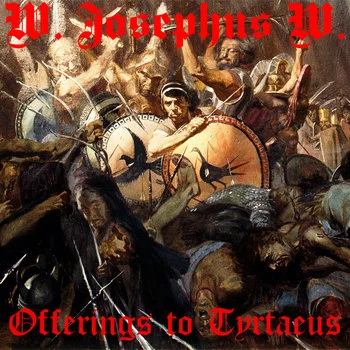
The Spartan in the bedroom: W. Josephus W. sets ancient war poetry to neofolk
A solo neofolk act from Lake Worth Beach, Florida released Offerings to Tyrtaeus on June 13, 2026 — two bedroom-recorded tracks adapting the 7th-century BC Spartan soldier-poet Tyrtaeus, with operatic vocals, electric guitar, and BandLab digital orchestration. Ten releases into his Bandcamp catalog, W. Josephus W. remains entirely outside mainstream music press; at $3, this is the underground at its most unmediated.

June 14, 2026 · 11:19 PM
1 subscriptions · 32 items
Genre: Neofolk / folk metal / traditional folk · Released: June 13, 2026 · Label: Self-released · Listen: wjosephusw.bandcamp.com
In 2026, a solo artist from Lake Worth Beach, Florida recorded himself singing words written by a Spartan soldier-poet who died around 650 BC. He played electric guitar and acoustic guitar in his bedroom. A collaborator named Dave Hatfield tracked electric guitar, bass, and drums. They added synthesized strings, brass, flute, and bass choir through BandLab. The whole thing runs seven minutes and twenty-eight seconds. No label. No press release. No reviews anywhere. 1
That's the release. That's also the argument for it.
Tyrtaeus, and why anyone is still singing him
Tyrtaeus was a Spartan poet active in the seventh century BC, during the Second Messenian War. He wrote elegies and marching songs — the Greek embateria — meant to be sung by soldiers moving into formation. 1 Almost nothing of his work survived intact; what exists are fragments, mostly quoted by later authors who found them worth preserving. The poems are not subtle. They describe the glory of dying in the front rank, the shame of flight, the specific physical fact of standing your ground when the man next to you might not.
Modern classicists have not always been kind to him. W. Josephus W. — who self-identifies as "a poet and Traditionalist surfing the Kali Yuga" — acknowledges this with unusual directness: "Critics these days say it's not particularly good poetry but I enjoy it nonetheless." 1 That sentence does a lot of work. It acknowledges the critical consensus and then simply sets it aside. The artist is not arguing that Tyrtaeus deserves reevaluation. He is saying he finds the poems worth singing, and so he sang them.
That's a more honest curatorial stance than most acts working with ancient texts manage.
What the two tracks actually do
"The March to Plataea" opens the release at 3:26. The title points to 479 BC, when the Greek alliance gathered at Plataea to finally break the Persian invasion — the last major land battle of the Greco-Persian Wars. The track functions as exactly what it sounds like: a march. There's a processional weight to the arrangement, where the synthesized brass and strings fill the space that orchestras would have occupied in a film score, but the home-recorded grain of the guitar keeps it grounded. This isn't a cinematic reconstruction. It's closer to a campfire version of a thing that once had more grandeur.
"Tyrtaeus' Warsong" runs 4:02 and is the more direct Tyrtaean adaptation — the older poems rendered into English and set against electric guitar and the fuller synthetic ensemble. The vocal approach leans operatic in places, which sits strangely and correctly against the bedroom-recorded production. It should feel incongruous. Ancient war poetry was always meant to be performed beyond normal conversational scale; the grandiosity is the point. 1
The production method deserves a closer look. W. Josephus W. handled vocals, electric guitar, synthesizer, and acoustic guitar. Hatfield tracked the rhythm section. The synthesizer layers were built entirely inside BandLab — strings, brass, flute, and bass chorus patches assembled digitally. 1 The result is a recording that occupies a specific neofolk register: warm analog-ish recording of live instruments with digital orchestration tucked underneath. It's a genre approach that bands like Death in June and Sol Invictus made workable in the 1980s. W. Josephus W. uses it without irony or nostalgia — it's just the correct toolkit for this material.
Who W. Josephus W. is

The artist is based in Lake Worth Beach, Florida, and describes his practice in terms that don't belong to any particular scene: "I am a poet and Traditionalist surfing the Kali Yuga. I bear in my left hand a guitar and in my breast a spirit overflowing with song." 2 The Kali Yuga reference is Hindu cosmological — the final, most degenerate age of the current world cycle, a concept that has been adopted by traditionalist and perennialist philosophers as a framework for understanding cultural decline. It's an unusual thing to put in a Bandcamp bio, and it places W. Josephus W. squarely in the tradition of neofolk acts that approach music as a form of philosophical testimony rather than entertainment.
Offerings to Tyrtaeus is his tenth Bandcamp release. 2 No mainstream press has covered any of them. No streaming platform data is publicly available. The full catalog runs $36.98 at 15% discount — about three-and-a-half dollars per release. This is the underground in its most basic form: consistent output, no institutional support, available to anyone with three dollars and an internet connection.
Sparta itself is relevant context here. W. Josephus W. notes that the popular image of Sparta as purely militaristic misses something: Spartan culture had a developed tradition of poetry, music, and communal dance. 1 Tyrtaeus was a product of that culture — a poet embedded in a military society, producing art that was also a functional tool of war. The gap between those two things is smaller than it looks from the outside. W. Josephus W.'s project is partly an act of restoration: the songs were originally meant to be sung, and he is singing them.
Should you listen
The Bandcamp release is available now at a minimum price of $3 USD, with MP3 and FLAC download and unlimited streaming via the Bandcamp app. 1 Stream and download at wjosephusw.bandcamp.com/album/offerings-to-tyrtaeus.
If neofolk is already in your listening rotation — if Death in June, Wardruna, or Faun appear anywhere in your library — this is a direct extension of something you already understand, made with less production budget and more philosophical clarity than most. If you've never heard the genre, this is a reasonable entry point precisely because it's so stripped down. Nothing is obscuring the core idea: old words, live instruments, a person who means them.
Seven minutes and twenty-eight seconds. Two tracks. Released June 13, 2026, from a city in Florida, by a poet who is still singing a Spartan soldier's words.
Cover image from Offerings to Tyrtaeus | W. Josephus W. — Frank Frazetta artwork.
References
- 1Offerings to Tyrtaeus \
- 2Music \
Add more perspectives or context around this Post.